
Introduction
This demo illustrates the aperture problem as described by Adelson & Movshon (1982), which refers to the perceived orientation of motion in grating stimuli viewed through an aperture, as well as the factors underlying perceived movement coherence. This experiment presents a plaid stimulus, along with the two underlying grating stimuli used to create it, so that the participant can observe the result of their combination.
Prerequisites
-
LabMaestro is installed and activated
Project Files
Project Overview
Epoch 1 - Congruent Movement
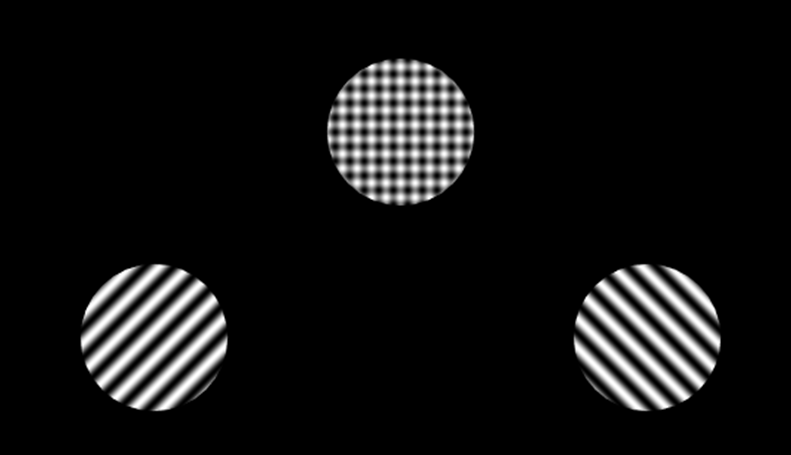
The first Epoch shows a combination of a 2 cycles/degree Grating oriented at -45 degrees clockwise, moving at a drift rate of 1 cycle/second, and an identical grating this time oriented at 45 degrees clockwise. Combined, these gratings create a plaid stimulus that appears to drift from bottom to top. The movement observed in the plaid stimulus is congruent (appearing to be a single entity, independent of both gratings below).
Epoch 2 - Effect of Spatial Frequency on Coherent Movement Perception
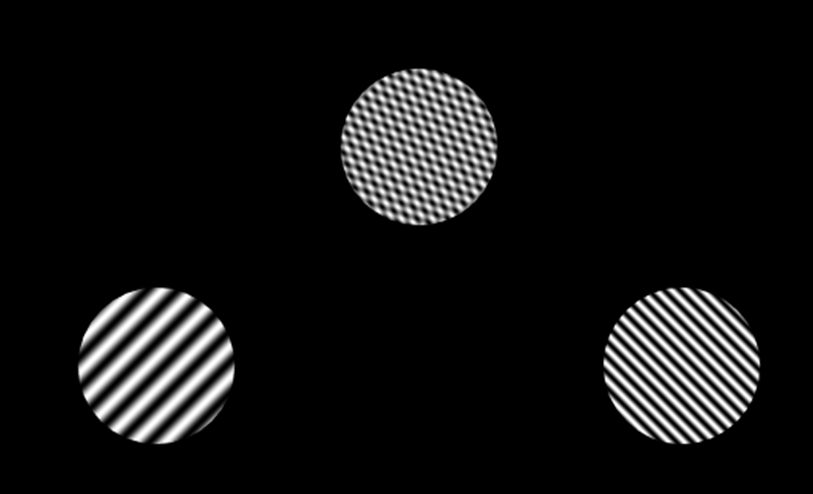
In the second Epoch, all parameters are the same, except the spatial frequency of the right grating, which is now 4 cycles per degree, slowing the motion (as it is defined in cycles/second). As a result, the movement in the top plaid appears skewed to the left. Correcting for this by accelerating the movement of the right grating eliminates this effect. (You can do this by changing the Drift Rate parameter of both the grating in the Right2 region, as well as RightMotion in the Combined2 region).
Epoch 3 - Unexpected Coherent Motion
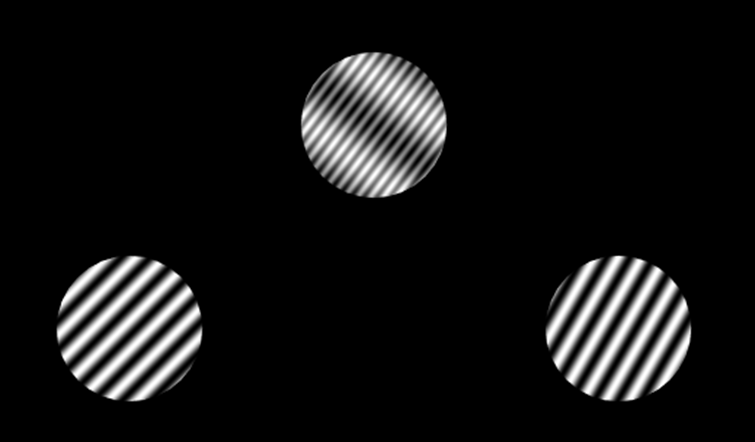
The third Epoch shows an interesting phenomenon: the left grating remains identical to the previous epochs but is moving in the opposite direction, towards the lower right. The right grating is oriented at -30 degrees and also moves towards the lower right, but at a faster speed (2 cycles/second). Based on what we’ve seen in previous epochs, we would expect a pattern of movement between the gratings, skewed towards the right grating because it is faster.
However, if perceived as congruent, the resulting stimulus moves in a completely different direction: towards the upper right. While counterintuitive, the velocity-space representations of both grating stimuli predict this resulting perception, as described by Adelson & Movshon (1982). If the plaid is perceived as incongruent (i.e., two gratings “sliding” on each other), one appears to move towards the upper right, and another towards the lower left.
Epoch 4 - Diminishing Perception of Coherence as a Function of Spatial Frequency
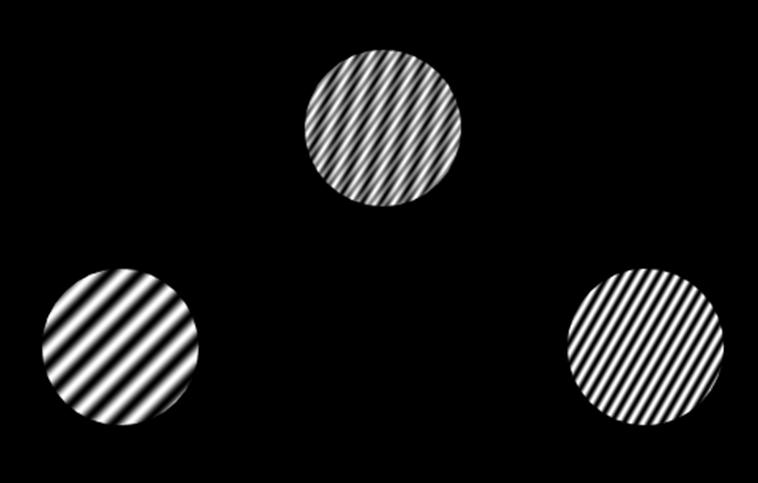
Finally, Epoch 4 uses the same basic motion and stimuli as Epoch 3, but doubles the spatial frequency of the right grating, thereby reducing perceived coherence in the plaid stimulus (it is now more likely to appear as two superimposed gratings moving independently). This replicates findings by Adelson & Movshon (1982), who showed that spatial frequency impacted the perception of coherent motion, leading the authors to suggest that motion-detection mechanisms are tuned to spatial frequency.
Adelson & Movshon (1982) have also shown that contrast plays a role in perceived coherence. You can experiment with this by changing the grating stimulus's amplitude at various points in the demo.